Why Does Macbeth Kill Again? What Is His Motivation?
Characters
Macbeth has a small-scale cast of characters. Macbeth and his wife, Lady Macbeth have the main roles and their ambition and eventual downfall is primal to the storyline.
Macbeth in Macbeth
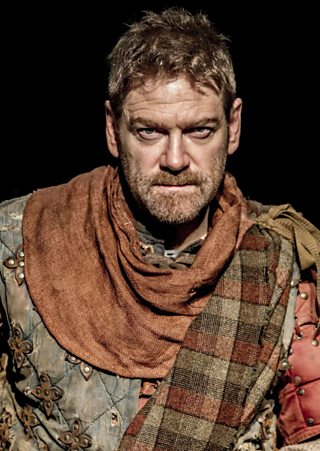
Macbeth is a complex character who changes throughout the grade of the play. He is clearly a brave warrior and leader at the start of the drama but he falls victim to the Witches' predictions. It is unclear whether they plant ideas in his listen or whether they merely highlight thoughts that he has already had. In a serial of soliloquies he repeatedly questions himself nearly his motives for killing the King but is eventually persuaded to proceed by his forceful married woman.
Having committed murder he finds himself caught in a spiral of evil from which he can see no escape. His actions go less heroic and more cowardly as he continues to murder and terrorise others in order to hold on to his power. Towards the end of the play, when he realises that he is doomed, he briefly returns to his old heroic self.
| How is Macbeth similar this? | Evidence | Analysis | |
|---|---|---|---|
| Ambitious | At the start of the play, Macbeth is Thane of Glamis. He rapidly becomes the more powerful Thane of Cawdor and then murders his way to get and remain Rex of Scotland . The Witches' predictions seem to waken the ambition already in him and he is spurred on by his wife. | The prince of Cumberland: That is a step / On which I must autumn downward, or else o'er-leap, / For in my way it lies. Stars, hibernate your fires; / Let not light run across my black and deep desires, / The center wink at the hand. Yet let that be, / Which the eye fears, when it is done, to meet. (Act 1 Scene 4) | Macbeth is conspicuously worried past the strength of his ain appetite which he refers to equally black and deep desires . He knows there volition be obstacles in his way just is determined to go round them. He but hopes that nobody volition run across what he is up to which is why he wants the stars to stop shining. |
| Brave | At the get-go of the play, Macbeth shows that he is a mighty warrior when he leads the Scottish troops to victory over an invading force. Duncan, the Rex, rewards him by making him Thane of Cawdor. At the end of the play, when he knows he is about to dice, Macbeth regains some of his old bravery , as he faces Macduff in unmarried combat. | For brave Macbeth-- well he deserves that proper name -- / Disdaining fortune, with his brandished steel, / Which smoked with bloody execution, / Like Valour'southward minion carved out his passage / Till he faced the slave, Which ne'er shook hands, nor bade bye to him, / Till he unseamed him from the nave to th'chaps, / And fixed his head upon our battlements. (Human activity one Scene two) | The Captain describes Macbeth's actions on the battlefield peculiarly when he seeks out and kills the traitor Macdonwald. The Helm uses a number of strong verbs and adjectives to testify how brave Macbeth has been: 'brandished', 'smoked', 'carved', 'unseamed', 'fixed'. |
| Changeable | Macbeth keeps irresolute his mind about whether to murder Duncan or not . This is particularily and then in the early part of the play. His appetite conflicts with his sense of loyalty and morality. Lady Macbeth is key to persuading him and keeping him adamant. | We will proceed no further in this business. / He hath honoured me of tardily, and I accept bought / Golden opinions from all sorts of people, / Which would be worn now in their newest gloss, / Not cast aside so soon. I am settled and bend upwardly / Each corporeal agent to this terrible feat. (Act one Scene 7) | Macbeth has simply spent a hard time convincing himself that killing the King is wrong. He tells Lady Macbeth that he volition not carry out the human activity. Within the space of a couple of minutes she argues the case for Duncan's death and Macbeth is, once again, set on murder. |
| Guilty conscience | Throughout the play, Macbeth is tormented by thoughts of the evil things he has done . However, he is caught in a spiral of evil and does not seem able to stop himself. | (seeing the GHOST) Avaunt, and quit my sight! Let the earth hide thee! / Thy bones are marrowless, thy blood is common cold; / Thou hast no speculation in those eyes / Which thou dost glare with. (Human action 3 Scene 4) | Banquo's ghost appears to Macbeth lonely, showing his overactive imagination triggered by a guilty censor . Although he is now a rex, Macbeth cannot command his own emotions and feels irrevocably set on this form of action. The courtroom thinks he is going mad. |
Social and historical context
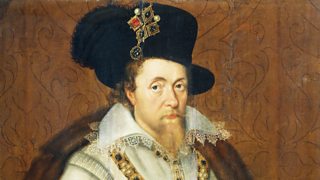
A rex in Shakespeare'southward fourth dimension was thought to dominion by 'divine correct'. This meant that God had chosen that person directly to rule over others. The killing of a king (known as regicide) was therefore considered to exist simply near the worst criminal offence that anyone could commit. That is why Macbeth'southward determination to murder Duncan seemed and then horrific to an audience of the time and why the murderer has such a guilty conscience. The new King on the throne of England, James I (likewise known as James VI of Scotland), was paranoid about assassination attempts. This was unsurprising, since the infamous Gunpowder Plot to accident upwardly the King and Parliament had taken place just months earlier Macbeth was offset performed.
Analysing the evidence
Is this a dagger which I see earlier me, The handle toward my hand? Come, permit me clutch thee: I accept thee not, and nonetheless I see thee still. Art m not, fatal vision, sensible To feeling as to sight? Or art m but A dagger of the listen, a false creation, Proceeding from the heat-oppressèd encephalon? I come across thee nonetheless, in form equally palpable As this which at present I draw.(Human activity 2 Scene 1)
- Question
-
Why are these thoughts key to Macbeth's hereafter grapheme and actions?
-
How to analyse the quote:
"Is this a dagger which I see before me, The handle toward my hand? Come, permit me clutch thee: I take thee not, and notwithstanding I encounter thee withal. Art thousand not, fatal vision , sensible To feeling as to sight? Or art 1000 but A dagger of the mind, a false creation , Proceeding from the estrus-oppressèd brain? I see thee yet , in course every bit palpable Every bit this which now I draw ." (Deed 2 Scene 1)
- 'dagger' / 'a dagger of the heed' - the Macbeths intend to utilize a dagger every bit the murder weapon. After the murder Macbeth's conscience will continue to stab him - only like a dagger
- 'I accept thee non, and yet I see thee still' / 'I see thee yet' - Macbeth's mind is very confused equally he tries to hold the non-existent weapon
- 'fatal vision' / 'fake creation' - is the dagger something conjured up past evil spirits or Macbeth's ain conscience?
- 'this which now I draw' - Macbeth compares the imaginary dagger to the 1 he is actually holding
How to use this in an essay:
Macbeth is again having doubts about murdering Duncan and sees a vision of the intended murder weapon - a 'dagger of the listen' . He is not totally sure at this phase whether the dagger has been sent by evil spirits to torment him ( 'fatal vision' ) or whether it has been invented by his own overactive imagination and his guilty censor ( 'false creation' ). Although he tin see information technology clearly he cannot physically concur it ( 'I have thee not, and yet I come across thee still' / 'I see thee still' ). Then he grasps the real dagger which he is carrying ( 'this which now I draw' ) as his troubled mind begins to fill with images of evil and thoughts of death.
Source: https://www.bbc.co.uk/bitesize/guides/zpy9tyc/revision/2
0 Response to "Why Does Macbeth Kill Again? What Is His Motivation?"
Post a Comment