Where Can I Buy Minute Maid Orange Juice With a High Pulp
 | |
| Nutritional treasure per 248 g (1 cup) | |
|---|---|
| Energy | 468.6 kJ (112.0 kcal) |
| Carbohydrates | 25.79 |
| Sugars | 20.83 |
| Dietary fiber | 0.50 |
| Stout | 0.50 |
| Saturated | 0.06 |
| Unsaturated | 0.089 |
| Polyunsaturated | 0.099 |
| Protein | 1.74 |
| Vitamins | Quantity %DV † |
| Vitamin A equiv. | 3% 25 μg |
| Vitamin A | 496 IU |
| Thiamine (B1) | 19% 0.223 milligram |
| Riboflavin (B2) | 6% 0.074 mg |
| Niacin (B3) | 7% 0.992 mg |
| B-complex vitamin6 | 8% 0.099 Mg |
| Folate (B9) | 19% 74 μg |
| Vitamin B complex12 | 0% 0.00 μg |
| Vitamin C | 149% 124.0 mg |
| Viosterol | 0% 0.0 IU |
| Vitamin E | 1% 0.10 mg |
| Vitamin K | 0% 0.2 μg |
| Minerals | Quantity %DV † |
| Calcium | 3% 27 mg |
| Iron | 4% 0.50 mg |
| Magnesium | 8% 27 mg |
| Phosphorus | 6% 42 magnesium |
| Potassium | 11% 496 mg |
| Sodium | 0% 2 mg |
| Atomic number 30 | 1% 0.12 mg |
| Other constituents | Quantity |
| Water | 218.98 |
| Link to USDA Database entry | |
| |
| †Percentages are roughly approximated using US recommendations for adults. Beginning: USDA FoodData Central | |
Orange succus is a liquid extract of the orange fruit, produced by squeezing operating room reaming oranges. It comes in several different varieties, including line orangeness, navel oranges, valencia orange, clementine, and tangerine. As well as variations in oranges used, some varieties include differing amounts of juice vesicles, known as "pulp" in American English, and "(juicy) bits" in British English. These vesicles bear the succus of the orangish and can make up left in or distant during the manufacturing process. How toothsome these vesicles are depend upon many factors, such as species, variety, and season. In American English language, the beverage name is often abbreviated as "OJ".
Commercial orange juice with a long ledge life is made away pasteurizing the succus and removing the oxygen from it. This removes very much of the taste, necessitating the later addition of a flavor pack, broadly made from orange products. Additionally, some juice is further treated by drying and later rehydrating the juice, or by concentrating the succus and later adding water to the concentrate.
The health value of Orange juice is debatable: IT has a high concentration of vitamin C, but also a very high concentration of simple sugars, comparable soft drinks.[1] [2] [3] As a resultant, some government nutritionary advice has been adjusted to encourage substitution of orange juice with unfinished fruit, which is digested to a greater extent slowly, and limit point daily consumption.[4] [5]
Chronicle
During Second World War, American soldiers rejected vitamin C-packed maize crystals because of their unappetizing taste. Thus the government searched for a food that would fulfill the nutritional of necessity of the soldiers, rich person a desirable taste, and prevent diseases such as scurvy. The federal government and the Florida Department of Citrous fruit worked with a group of scientists to develop a product superior to the canned orangeness succus visible in the 1940s. The result was frozen concentrated orange juice; unfortunately, this was non until ternion eld after the war had ended.[6]
By 1949, orange succus processing plants in FL were producing over 10 billion gallons of concentrated orange juice. Consumers liked centralised canned orange juice as it was cheap, tasty, convenient, and high in vitamin C. The preparation was round-eyed: empty the container of frozen concentrate into a careful volume of water and stimulate. However, past the 1980s, food scientists developed a fresher-tasting juice notable as reconstituted ready-to-serve juice. Eventually in the 1990s, "not from concentrate" (NFC) orange juice was developed.[6] Orange juice is a common breakfast potable in the U.S..[7]
Due to the grandness of oranges to the economy of Everglade State, "the succus obtained from mature oranges of the species Citrus sinensis and hybrids thereof" was adopted as the formalised beverage of Sunshine State in 1967.[8] [9]
Alimentation

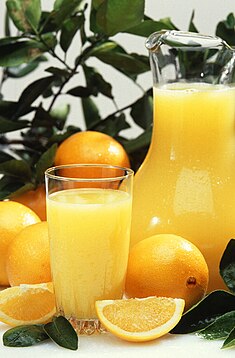
A glass of orange juice with pulp
A cup serving of rare, fresh Orange River juice, amounting to 248 grams or 8 ounces, has 124 mg of vitamin C (>100% RDI).[10] It has 20.8 g of sugars, 112 Calories and almost 26 grams of carbohydrates.[11] [ unreliable source? ] It as wel supplies potassium, thiamin, and folate.[ mention needed ]
Citrus juices contain flavonoids (especially in the pulp) that may have wellness benefits. Orange juice is too a source of the antioxidant hesperidin. Because of its citric acidic content, orange juice is acidic, with a characteristic pH of around 3.5.[12]
Consumption of orangeness juice is under preliminary explore for the potential to ameliorate nutrition and affect prolonged diseases.[13]
Commercial Orange juice and concentrate
Icebound concentrated orange juice
Inferior squeezed orange juice is pasteurized and filtered ahead being gaseous under vacuum cleaner and rut. After removal of most of the water, this concentrate, about 65% lucre by weight, is then stored at about 10 °F (−12 °C). Essences, Vitamin C, and oils extracted during the vacuum concentration cognitive process may be added back to restore flavor and nourishment (see below).
When water is added to freshly thawed thick orange juice, it is aforementioned to be reconstituted.[14]
The product was developed in 1948 at the University of Florida's Citrus Research and Education Center. Since, it has emerged as a soft commodity, and futures contracts have listed in New York since 1966. Options along FCOJ were introduced in 1985. From the late 1950s to the mid-1980s, the product had the greatest chromatic juice market share, but not-from-concentrate juices surpassed FCOJ in the 1980s.[15]
Not from concentrate
Orange juice that is pasteurised and then oversubscribed to consumers without having been concentrated is labelled as "not from concentrate". Even as "from concentrate" processing, most "non from concentrate" processing reduces the undyed flavor from the juice. The largest producers of "not from concentrate" use a production process where the juice is placed in sterile storage, with the oxygen stripped from it, for up to a class.
Removing the atomic number 8 also strips down season-providing compounds, and so manufacturers sum up a flavor pack in the final step,[16] which Cook's Illustrated magazine describes as containing "extremely engineered additives." Flavor battalion formulas vary by neighborhood, because consumers in different parts of the world have antithetical preferences related to sweetness, freshness and acidity.[17] According to the citrus diligence, the Food and Drug Administration does not require the contents of flavor packs to be careful on a merchandise's publicity.[18]
Nonpareil common ingredient of flavor packs is ethyl butyrate, a natural odour that people associate with freshness, and which is removed from juice during pasteurization and storage. Fudge's Illustrated sent juice samples to sovereign laboratories, and found that while fresh-squeezed juice naturally contained nearly 1.19 milligrams of ethyl butyrate per liter, succus that had been commercially processed had levels as high as 8.53 milligrams per l.[17]
Canned Orange River juice
A small fraction of fresh Orange juice is tinned. Canned orange juice retains vitamin C so much better than bottled juice.[19] The canned product loses flavor, however, when stored at room temperature for more 12 weeks.[20] In the archeozoic years of transcribed orange succus, the acidity of the juice caused the juice to have a all-metal taste. In 1931, Dr. Philip Phillips developed a newsflash pasteurization process that eliminated this job and significantly enhanced the market for recorded Orange River juice.[21]
Freshly squeezed, unpasteurized juice

Mexican capital merchant with his freshly squeezed orange juice, March 2010
Fresh-squeezed, the unpasteurised juice is the closest to consuming the orange itself. This version of the juice consists of oranges that are squeezed and so bottled without having whatever additives OR flavor packs inserted. The juice is not subjected to pasteurization. Depending on storage temperature, impudently squeezed, unpasteurized Orange River juice can have a shelf life of 5 to 23 years.[22]
Major orange juice brands
In the U.S., the major orange juice blade is Tropicana Products (owned by PepsiCo Inc.), which possesses nearly 65%[ citation needed ] of the market ploughshare. Tropicana also has a large mien in Latin America, Europe, and Point Asia. Competing products include Minute Maid (of The Coca-Cola Company) and Florida's Natural (a Floridian agricultural co-op that differentiates itself from the competition past being locally owned and using only Florida mature oranges; Tropicana and Plainly Orange use a miscellany of domestic and foreign lineage).
In Australia, Daily Juice (closely-held by National Foods) is a major brand of partially fresh, part flash-frozen,[23] orange juice.
In the GB, major orange succus brands include Del Monte and Princes.
Additives
Some producers add citric acid or vitamin C to juice on the far side what is course found in the orange. Some also include other nutrients. Often, additional vitamin C is added to replace that wiped out in pasteurization. Additive calcium may glucinium added. Vitamin D, non found naturally in oranges, may be added as well. Sometimes omega-3 roly-poly acids from fish oils are added to orange succus.[24] Low-virulent varieties of Orange River juice also are available.
FCOJ producers broadly speaking habituate evaporators to dispatch much of the pee from the juice in lodg to decrease its weight and decrease fare costs.[25] Other juice producers generally de-aerate the juice so that it can cost sold much later in the year.[26]
Because so much processes remove the distinct aroma compounds that give orange juice a fresh-squeezed taste, producers later add back these compounds in a proprietary mixture, called a "flavor pack", ready to meliorate the try and to insure a concordant class-round taste.[25] [27] The compounds in the flavor packs are derived from orange peels.[27] Producers do not mention the addition of flavor packs on the label of the chromatic succus.[27]
Types of orange
Grassroots orange juice is made from the sweet orange. Diametric cultivars (for instance, Valencia, Hamlin) have different properties, and a producer Crataegus oxycantha mix cultivar juices to start out the in demand perceptiveness. Orange juice usually varies between shades of orange and yellow, although some ruby red or pedigree orange varieties are a chromatic or even pinkish. This is collect to different pigmentation in deep red red oranges.
The blood orange is a mutant of the sweet orange. The mandarin orange and the clementine and tangerine varieties are oft utilized for sparkling juice drinks.
Many brands of organic orange juices have become disposable on the market.
Processing and manufacture
Industry of stock-still concentrated orange juice
Film clip exhibit the production and packaging of frozen orange juice concentrate.
The processing of orangeness to frozen concentrated orangish juice begins with testing the orange fruit for quality to ensure it is safe for the process. So the fruit is cleansed and washed thoroughly and orange oil is taken from the peel of the orange. Next, the juice is extracted from the orange and is screened in order to remove seeds and large pieces of pulp. The succus is then heated to 190 to 200 °F in order to inactivate natural enzymes found in the juice. The concentration step occurs in a high-altitude vacuum cleaner evaporator where the water message in the succus is evaporated while the succus lettuce compounds and solids are concentrated. The vacuum evaporator is a low temperature decreasing-film chemical mechanism, which operates at a temperature between 60 and 80 °F. Evaporators work in a continuous manner in that fresh juice is added equally concentrate is being constantly removed. The concentration process increases the soluble solid allot of the juice from 12 °Brix to 60-70 °Brix.[28]
The concentrated juice is held in a cold wall tank and is stored at or below 35 °F to prevent browning and growth of undesired flavors. Following, a small amount of fresh succus is added to the concentrated juice to reinstate natural and fresh flavors of orange juice that have been lost through the assiduity process. Specific cold-pressed orange oils are used to fix the confiscate scent and volatile flavors. After the addition of fresh juice, the brix content is reduced to 42 °F. The rested succus is referred to as "cut-back" in the diligence and attributes to 7-10% of the total juice. Orange peel oil is too added if the oil substance is below the required level. The contract is then further cooled in a continuous cooler or rimed wall up tank to 20 to 25 °F. The concentrate is canned using steam injection methods to sterilize the lid and develop a void in the bum. The cans then get final freezing where they are conveyed on a cut belt in an breeze blast at -40 °F. After freezing, the product is stored at 0 °F in a cold warehouse.[28]
Fabricate of "not from centralise"
Single strength orange juice (SSOJ) can either be "not from decoct" (NFC) orange juice or succus that is reconstituted from a concentrate with the addition of water to orbit a unique single strength brix level. The processing of SSOJ as wel begins with the selection of orange. The most democratic types of chromatic wont to produce orange juice are the Pineapple orange, Valencia orange, and Washington Navel oranges from Everglade State and California. The manufacturing journey begins when oranges are delivered to processing plants by trucks holding about 35,000 to 40,000 pounds of yield. The fruit is unloaded at the plant for review and grading to remove unsuitable fruit in front the oranges enter the store bins. An automatic sampler contraption removes oranges for conclusion of acid and soluble solids. The bins are organized based connected ratio of soluble solids to acids ready to blend oranges appropriate to produce juice with uniform flavor. After the yield leaves the bins, they are scrubbed with detergent on a rotary thicket washer and later rinsed with potable water. Throughout the processing stages, there are multiple points with facilities that scrutinize oranges and toss out damaged fruit.[29]
The oranges then go done roller conveyors, which expose all sides of the fruit. The roller conveyors are efficiently built equally they are well lighted, installed at a roomy height, and breadth to ensure all inspectors can reach the fruit to determine inadequacies. Some reasons why fruit English hawthorn be rejected admit indication of stamp, rot, and ruptured peels. Afterwards, the oranges are separated based on size through machines preceding to juice extraction. There are a number of different shipway Orange succus manufacture leadership extract their oranges. Whatsoever common methods include halving the fruit and pressing/reaming the orange to extract juice from the orange. One instrument inserts a tube through the orange rind and forces the juice out through the subway by squeeze the entire orange. Despite the assortment of machines used to extract juices, all machines have commonalities in that they are rugged, fast, easy to clean and have the ability to slim peel extractives into the juice. The extracted succus product does not contain the Orange River peel, but it may contain pulp and seeds, which are removed past finishers.[29]
Finishers have a screw-type design that comprises a conical helical screw enclosed in a cylindrical screen with perforations the size of 0.020 to 0.045 inches. Thereafter, the over orange juice flows through blend tanks where the juice is tested for acid and soluble solids. At this stage, sugar can atomic number 4 added to the juice depending on if the product will be a sweetened or unsweetened beverage. Following mingling, the orange tree juice is deaerated where the air is incorporated into the juice during descent. The benefits of deaeration include the liquidation of foaming, which improves the uniformity of can fill and improvement regarding the efficiency of the heating plant exchanger. Orange River peel oil is essential for maximum feel, just according to U.S. standards for Grades of Canned Orange Juice, 0.03% of recoverable oil is permitted. Deoiling through with the use of vacuum cleaner distillment is the mechanics used to shape the amount of peel vegetable oil in the juice. Capsule separates the oil and the liquid distillate, which is returned to the juice.[29]
The next step is one of the most vital in the processing of orangish succus. Pasteurization is distinguished in destroying of course occurring enzymes that are associated with deterioration of the succus. Pectinesterase is infamous for its deteriorative natural action in orange juice. In the pasteurization serve, the juice is generally speedily heated to 197 °F for about 40 seconds. Several industry leaders consumption flash pasteurisation, which is carried out away tube-shaped operating theatre plate-character heat exchangers. In regularise to prevent overheating, roily flow is vital to heat the succus rapidly. Cans are filled with the pasteurised juice and inverted immediately to allow the juice to sterilize the in spite of appearanc parts of the lid. The orange juice occupied can is stamped and cooled to 90 to 100 °F aside spinning connected the conveyor belt belt under cool irrigate sprays. Quality of storage is determined by time and temperature. Juice moldiness equal stored at cool temperatures to prevent impairment.[29]
Standards and regulations
Regulations in Canada
For North American nation markets, orange juice mustiness be the fruit juice obtained from clean, heavy, and mature oranges.[30] The juice must also incorporate a minimum of 1.20 milliequivalents of free amino acids per 100 millilitres, contain a tokenish of 115 milligrams of potassium per 10 milliliters, and have a stripped-down absorbance value for total polyphenolics of 0.380.[31] Sweeteners such as sugar, invert sugar, dextrose operating theater glucose solids may Be added. The orange juice must have a Brix reading of at least 9.7, excluding the sweetening ingredients, and contain between 0.5 and 1.8 percent of acid by weight calculated as anhydrous citric acid.[30] Added orange essences, orange oils and orange pulp adjusted in accordance with good manufacturing practice is permitted. Orange juice is also permitted to contain simoleons, invert sugar, dextrose in dry form, glucose solids, a Class II preservative, amylase, cellulase and pectinase.[30]
Regulations in the USA
In the Unpartitioned States, Orange River succus is regulated and standardised by the Food and Drug Administration (Food and Drug Administration or USFDA) of the United States Department of Health and Human Services. According to the Food and Drug Administration, orange juice from concentrate is a mixture of water with frozen concentrated orange juice or concentrated orange juice for manufacturing.[32] Extra ingredients into the admixture may include fresh/frozen/pasteurized orange juice from mature oranges, orange oil, and orange mush.[17] What is more, one and only or many of the following optional sweetening ingredients Crataegus oxycantha be added: sugar, sugar syrup, invert sugar, invert sugar sirup, dextrose, corn syrup, dried corn syrup, glucose syrup, and dried glucose syrup.[32] The orange juice essential contain a minimum Brix level of 11.8, which indicates the percentage of orange juice soluble solids, excluding any added sweetening ingredients.[33]
Regulations in the UK
In the United Kingdom, chromatic juice from concentrate is a product of thickset fruit crush with the addition of water. Any lost flavour or pulp of the orange succus during the initial concentration serve may comprise restored in the ultimate product to be equivalent to an average typewrite of orange juice of the same kind. Whatsoever restored flavour or pulp must come from the assonant species of orange.[34] Sugar may be added to the chromatic juice for regulation the acidic taste or sweetening, but must not exceed 150g per l of orange juice.[34] Crossways the UK, the final orange juice from concentrate product must control a minimum Brix level of 11.2, excluding the extra sweetener ingredients.[35] [36] Vitamins and minerals whitethorn cost added to the orange succus in accord with Regularization (EC) 1925/2006.[37]
Carnal and chemical properties
Molecular piece of music
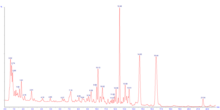
UV 280 nm chromatogram after UHPLC separation of commercial orange juice, showing, amongst other peaks, narirutin and hesperidin.
On a molecular floor, Orange juice is composed of organic acids, sugars, and phenolic compounds. The main organic acids found in orange succus are citric, malic, and ascorbic acid. The star sugars launch in orange juice are sucrose, glucose, and fructose. There are about 13 phenoplast compounds in orange juice including hydroxycinnamic acids, flavanones, hydroxybenzoic acids, hesperidin, narirutin, and ferulic acerb.[38]
Piece of music of the overcast
The cloud is the portion of suspended particles that range in size from 0.05 micrometers to a few hundred micrometers in orange juice. The cloud is prudent for several afferent attributes in orangeness succus including color, aroma, texture, and appreciation.[31] The unremitting medium of the befog consists of a solution of sugars, pectin, and organic acids piece the dispersed thing is formed through and through cellular tissue comminuted in fruit processing.[39] Specifically, the cloudiness of the juice is caused by pectin, protein, lipid, hemicellulose, cellulose, hesperidin, chromoplastids, amorphous particles, and oil color globules.[40] In especial the chemical composition of the cloud consists of 4.5-32% pectin, 34-52% protein, 25% lipids, 5.7% nitrogen, 2% hemicellulose, 2% ash tree, and less than 2% cellulose.[31]
Body
Orange juice is a suspension that consists of heterogeneous particles in a clear serum. A blood serum is the sack up supernatant after the hurriedness of the cloud through centrifugation. The previously mentioned cloud makes up a hulky component of the suspension.[31]
If the suspension in orange juice is not stable, the cloud particles can flocculate which causes the break to physically decompose. The cloud can break apart and the citrous fruit juice will clarify if the suspension becomes unstable.[40] The activity of pectin methyl esterase increased the interaction between pectin and cloud proteins, which light-emitting diode to protein-pectin flocculation. The incomprehensible bodily of the cloud clumps in conditions above 70 °C (158 °F) and at a pH of 3-4 at which proteins coagulate and flocculate. Cloud flocculation is enhanced at pH 3.5 and can result in illumination, which is ineligible in orange succus.[41]
The suspension is unstable when the zeta potential is less than 25 mv in order of magnitude. Zeta latent is a amount of the magnitude of electrostatic forces 'tween particles, which touch on repulsion, and attraction between particles. A low zeta value signifies that the repulsive forces leave not be able to overcome Caravan der Waals attractions betwixt mottle particles and thus begin to agglomerate. Agglomeration of cloud particles will prevent extricated flow characteristics, which is substance in the juice. A high zeta potentiality will curb particle-atom agglomeration and maintain the free flowing nature as well equally uniform dispersion in orange juice.[39]
The oil globules adsorbed to the cloud particles stabilize the suspension away decreasing the average concentration of particles to bring information technology closer thereto of the serum. However, large amounts of oil can be problematic as they suit complete breakdown of suspensions by causation cloud particles to float to the come out. The particles in the cloud have a negative charge that decreases with decreasing pH. In accordance of rights with cloud stability, the hydration of particles is more significant than their electrical charge.[40]
Heat treatment
When orange succus is heating plant treated there is an increase in the number of fine particles and decrease in that of coarse particles. The fine particles in particular are causative the appearance, color, and flavor of orangish succus. Heat treatment plays a vital role happening pulp volume, cloud constancy, blood serum turbidness, and blood serum viscousness. Heating system discussion stabilizes the cloud through enzyme inactivation and enhances the turbidity of a stable cloud formation. The increase in blood serum viscosity is due to the descent of pectic substances into the serum. Based on Stoke's law, the increase in blood serum viscosity is the cause for the increased befog constancy. In relation to pulp volume, the pulp from heated juices was finer and more compact than unheated juice pulp, which was copious and fluffy.[40]
Properties of pulp
In orange juice, flesh is causative desirable current properties, taste, flavor, and speak spirit. However, nonwoody orange juice precipitates based on a rate dependent on the diameter, density, and viscousness of the suspended particles as well as the suspending succus. Systematic to remain suspended in orange succus, pulp magazine particles moldiness have appropriate particle size, charge, and special somberness. Depending along type of processing method, the size of pulp particles ranges from 2–5 millimeters (0.08–0.2 in). Those that are smaller than 2 mm (0.08 in) are known to be more constant, so information technology is good to reduce the size of particles by incorporating hydrocolloids to the juice product. Hydrocolloids would decrease the value of sediment formation and decrease the decreasing rate of pulp particles.[42]
Hydrocolloids
Hydrocolloids are long-chain polymers that form gluey dispersions and gels if distributed in water. They bear a number of operational properties in food products including emulsifying, thickening, coating, gelling, and stabilization. The main reason hydrocolloids are used in foods is their capability to modify the rheology of nutrient systems. Hydrocolloids impact viscosity through rate of flow behavior and mechanical solid properties like texture.[43] Some mutual hydrocolloids that are accustomed brace succus products include gellan gum, sodium carboxymethylcellulose, xanthan, guar gum tree, and gum Arabic. The said hydrocolloids are mostly victimized in the production of artificial orange juices and are often referred to as synthetical hydrocolloids. Pectin is the hydrocolloid found in raw orange juices.[42]
Properties of pectin
Pectin is the soluble chemical compound material in the pulp of oranges, which contains 75% of carboxyl of arabinose and brain sugar. Cellulose compounds are complex heteropolysaccharides in that their chemical composition includes a chain social structure of lengthways-axial α-1.4-linked d-galacturonic acid building block along with blocks of L-rhamnose regions that have slope chains of arabinose, galactose, and xylose. Pectin methyl-esterase is the enzyme responsible for for hydrolyzing carboxymethyl esters and liberating free carboxyl groups and methyl alcohols. The free carboxyl groups interact with cations to form insoluble pectic acid bivalent metal ion complexes. These metal ion complexes precipitate in the juice and carry all the colloids in orange succus with it. The enzyme would flocculate the cloud and clarify the orange juice. Thus, in edict to keep the orange succus cloud intact, IT is vital to inactivate pectinesterase. Pectinesterase is inactivated aside heating the juice for 1 minute at 90 °C (194 °F).[31]
Interactions of pectin
The solution behavior of pectin is strongly influenced by a number of factors including atomic number 1 bonding, order type, and hydrophobic character. Hydrogen bonding is loved when pH is less than pKa spell the ionic character is favored when pH scale is greater than pKa. Ionic character relies along free carboxyl content, the presence of cations, and is golden at a advanced irrigate activity. Charge-tutelage repulsions on with the presence of neutral side irons are essential in inhibiting intermolecular association among pectin molecules. The methyl ester content in orange juice determines hydrophobic character, which is favored at first gear water activity.[44]
There is a specific interaction betwixt pectin and hesperidin through the sugar moieties in the hesperidin molecule. Through acid hydrolysis, the rhamnose and glucose sugar moieties are remote from hesperidin, which breaks the interaction between hesperidin and pectin. Hydrogen soldering plays a role in the specific interaction of neutral sugars of pectin and the clams mediety of hesperidin. A polymer that has a high biology content of unreactive sugar branches interacts with hesperidin more tightly and powerfully than that of a low content of neutral sugar branches. The fundamental interaction between pectin and hesperidin is one of the factors that enable the colloidal suspension in orange succus to be stable.[41]
See also
- Juicing
- List of juices
References
- ^ Saner, Emine (17 January 2014). "How yield juice went from health nutrient to junk food". The Guardian . Retrieved 25 September 2016.
- ^ Walter, Peter (12 January 2014). "Fruit juice should not be part of your five a day, says governing adviser". The Guardian . Retrieved 25 September 2016.
- ^ Quinn, Litigate. "Should I still drinking fruit succus?". BBC Good Food. BBC. Retrieved 25 September 2016.
- ^ Philipson, Alice. "Wean yourself off orange juice, says government health tsar". Daily Telegraph . Retrieved 25 Sept 2016.
- ^ "Water system, drinks and your health". NHS Choices. Position Health Service. Retrieved 25 September 2016.
- ^ a b Wernher Magnus Maximilian von Braun, Adee (6 February 2014). "Misapprehension Orange Juice as a Health Drink". The Atlantic.
- ^ Anderson, H. A. (2013). Breakfast: A Chronicle. The Meals Serial publication. AltaMira Press. p. 90. ISBN978-0-7591-2165-2 . Retrieved 25 July 2018.
- ^ "2012 Florida Statutes, Chapter 15.032". The Florida Senate. Retrieved 26 August 2012.
- ^ "Florida Memory, State Department drinkable of Florida". Florida Department of State, Division of Library and Info Services. Retrieved 26 August 2012.
- ^ "Nutriment Facts and Depth psychology for Orangeness juice, rare". Nutritiondata.mortal.com. Retrieved 11 November 2012.
- ^ "Chromatic Juice Nutrition Facts". verywellfit.
- ^ "Acids". British Soft Drinks Tie-u. Archived from the original on 26 Venerable 2006. Retrieved 12 September 2006.
- ^ Alhabeeb H, Sohouli MH, Lari A, Fatahi S, Shidfar F, Alomar O, Salem H, Atomic number 13-Badawi IA, Abu-Zaid A. (2020). "Encroachment of orange juice economic consumption on cardiovascular disease risk factors: a systematic review and meta-psychoanalysis of randomised-controlled trials". Critical Reviews in Food Scientific discipline and Nutrition. 22: 1–14. doi:10.1080/10408398.2020.1865263. PMID 33350317. CS1 maint: multiple names: authors list (link)
- ^ To prevent off-flavor, distilled or reverse osmosis filtered piss should be used when reconstituting quick-frozen juice, devoid of minerals, Cl, etc.[ credit necessary ]
- ^ "Frosty Concentrated Orange River Succus" (PDF). ICE Futures U.S.. 2012. Retrieved 11 November 2012.
- ^ Alice Walker, Andrea (14 May 2009). "Ask an Academician: Orange Juice". The New Yorker . Retrieved 29 July 2011.
- ^ a b c "Taste Test: Orange Juice". Cooks Illustrated. March–April 2014. Retrieved 23 November 2014.
- ^ Donaldson James, Susan. "California Woman Sues OJ Giant Tropicana Finished Flavor Packs". ABC Tidings. Retrieved 30 January 2012.
- ^ Journal of Food Science and Technology - Google Boeken. 1 Jan 2004. Retrieved 11 November 2012.
- ^ Yiu H. Hu, József Barta Handbook of Fruits and Fruit Processing. Blackwell Publishing, 2006. p. 327.
- ^ Dickinson, Joy (7 January 2007). "Commerce Department Phillips: The Real Deal". Orlando Picke . Retrieved 15 January 2014.
- ^ Fellers, P.J. (November 1988). "Shelf Life and Quality of Freshly Squeezed, Unpasteurized, Polyethylene-Bottled Citrus Juice". Journal of Food Science. 53 (6): 1699–1702. doi:10.1111/j.1365-2621.1988.tb07819.x.
- ^ "Statement from National Foods". Au.todaytonight.yahoo.com. 5 July 2010. Archived from the original on 4 October 2013. Retrieved 13 November 2012.
- ^ "Empire State Times Clause on Orange Succus Additives". The New York Times. 17 September 2008. Retrieved 13 November 2012.
- ^ a b Flores, Alfredo (15 September 2004). "Fashioning Orange Juice Sense of taste Even Better". Agricultural Inquiry Service. United States Department of Agriculture.
- ^ "DEAERATION AND PASTEURIZATION EFFECTS ON THE ORANGE Succus AROMATIC FRACTION". WWW.ars.usda.gov . Retrieved 9 August 2016.
- ^ a b c Kay, Liz F (17 October 2010). "Don't Get Squeezed When Shopping for Juice". The Baltimore Lord's Day.
- ^ a b Matthews, Richard F. (April 1994). "Unmelted Concentrated Orange Succus From Florida Oranges".
- ^ a b c d Agriculture Department Research Service. "CHEMISTRY AND TECHNOLOGY OF Citrus fruit, CITRUS Merchandise; AND BYPRODUCTS." United States Agriculture Department, 1956. Web. 11 December 2016.
- ^ a b c "Fused Canadian Food and Drug Regulations (C.R.C., c. 870)". laws.justice.gc.atomic number 20 . Retrieved 14 July 2017.
- ^ a b c d e Kyriakidis, N.B (November 1999). "Practice of pectinesterase for detection of hydrocolloids addition in natural orangish juice". Food Hydrocolloids. 13 (6): 497–500. Department of the Interior:10.1016/S0268-005X(99)00034-X.
- ^ a b "Code of Federal Regulations Sec. 146.145". WWW.accessdata.fda.gov. Archived from the original on 15 Sep 2003. Retrieved 18 July 2017.
- ^ "Code of Northern Regulations Sec. 101.30". www.accessdata.fda.gov. Archived from the original happening 14 Sept 2003. Retrieved 18 July 2017.
- ^ a b "The Fruit Juices and Yield Nectars Regulations 2007" (PDF). Archived from the original (PDF) on 4 July 2016. Retrieved 18 July 2017.
- ^ "Circumboreal Ireland Yield Juices and Fruit Nectars Regulations 2013" (PDF). www.food for thought.gov.U.K.. Archived from the underivative (PDF) on 6 August 2017. Retrieved 20 July 2017.
- ^ "Cambri Yield Juices and Fruit Nectars Regulations 2013" (PDF). web.nutrient.gov.uk. Archived from the original (PDF) connected 6 August 2017. Retrieved 20 July 2017.
- ^ "Continent Rule (EC) No. 1925/2006". www.gov.uk . Retrieved 20 July 2017.
- ^ Kelebek, Hasim; Selli, Serkan; Canbas, Ahmet; Cabaroglu, Turgut (March 2009). "HPLC determination of organic acids, sugars, phenolic resin compositions and antioxidant content of orange juice and orange wine made from a Turkish cv. Kozan". Microchemical Journal. 91 (2): 187–192. Department of the Interior:10.1016/j.microc.2008.10.008.
- ^ a b Filippi, M. V.; Genovese, D. B.; Lozano, J. E. (2008). "Zeta-Potential every bit a Agency to Determine Optimal Conditions During Fruit crush Clarification". Food Engineering: Integrated Approaches. Food Engineering series. pp. 391–397. doi:10.1007/978-0-387-75430-7_29. ISBN978-0-387-75429-1.
- ^ a b c d Mizrahi, Shimon; Berk, Zeki (May 1970). "Physico-chemical characteristics of orange succus cloud". Daybook of the Science of Food and Agriculture. 21 (5): 250–253. doi:10.1002/jsfa.2740210508.
- ^ a b Ackerley, Jennifer Lynn (August 2002). Clarification of Valencia orange succus is influenced past specific action of thermolabile pectinmethylesterase, inactive PME-pectin complexes and the changes in serum soluble components (Dissertation). hdl:10724/29473.
- ^ a b Bagheri, Leila; Mousavi, Mohammad E.; Madadlou, Ashkan (2 September 2014). "Stability and Physics Properties of Suspended Pulp Particles Containing Orange Succus Stabilized by Gellan Gum". Journal of Dispersion Science and Technology. 35 (9): 1222–1229. DoI:10.1080/01932691.2013.834422. S2CID 95127674.
- ^ Milani, Jafar; Maleki, Gisoo (2012). "Hydrocolloids in Food Industry". Food Industrial Processes - Methods and Equipment. doi:10.5772/32358. ISBN978-953-307-905-9.
- ^ Klavons, Jerome A.; Bennett, Raymond D. (May 1995). "Preparation of Alkyl group Esters of Pectin and Pectic Acid". Journal of Food for thought Science. 60 (3): 513–515. doi:10.1111/j.1365-2621.1995.tb09815.x.
Advance Reading
- Alissa Hamilton: Squeezed: What You Don't Cognize about Orange Juice, Yale Agrarian Studies, 2010, ISBN 0-300-16455-6
External links
- Orange juice production Production summons and distinction between juice products
- Brief film clip of orange tree juice processing from 1968. From the Department of State Depository library & Archives of FL
- Biological orange succus processing Commercial enterprise processing of natural orange juice
Where Can I Buy Minute Maid Orange Juice With a High Pulp
Source: https://en.wikipedia.org/wiki/Orange_juice
0 Response to "Where Can I Buy Minute Maid Orange Juice With a High Pulp"
Post a Comment